NOTE: A local association threw an amazing celebration of America’s 250. They asked me to share my thoughts on why it was important to celebrate this milestone as a nation. What follows is my attempt to answer the question in an allotted time - balancing two factions in our country that seem to focus on one side of our history or the other when it is actually the beautiful truth of “and.”
Thank you for the honor of sharing some thoughts tonight.
We are 350 million Americans. Yet we are only 4.2% of the world’s population.
We are different. We are few. We live in tough times.
At 250 years, the United States endures as the world’s oldest large constitutional republic, the oldest continuous federal republic, and a home to one of the oldest written constitutions still in force.
This is why our 250th birthday is worth celebrating.
We are the heirs to what so few could dream, fewer tried, and fewer still - achieved.
A birthday is for joy, for thought (and reflection), and for vows.
Now at 250, the democracy of our dead – those citizens who have gone before us - invites us to learn, to reflect, to vow.
Our Republic is never finished. It asks of us hard work.
America never stops building, never stops moving toward a more perfect union. We inherit that work. Our charge is simple, and heavy: Preserve it, Protect it, and Pass it on.
If we do our part, we leave behind a better Republic than the one we received.
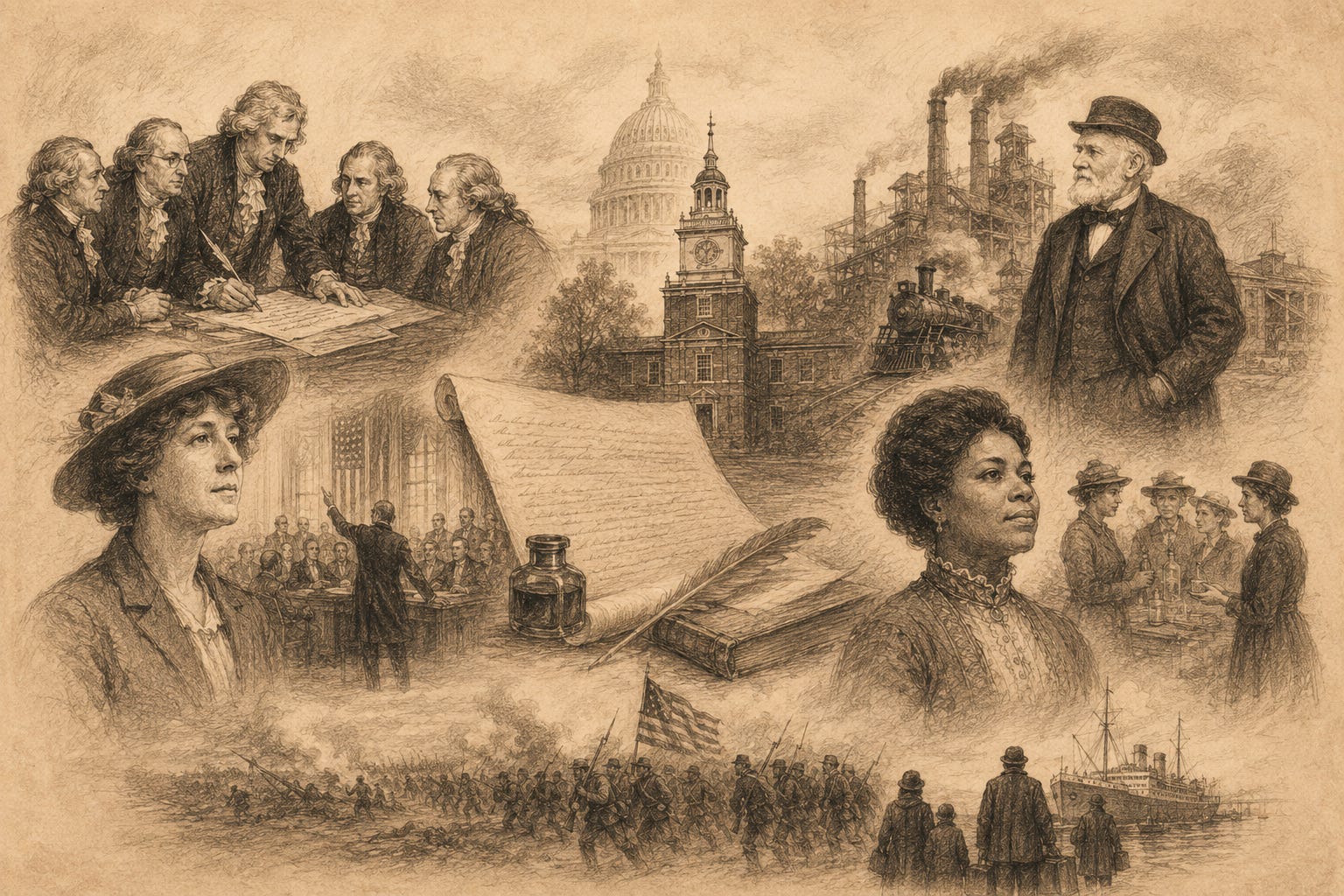
Tonight, a short sprint through our history. Three themes. Humbly offered to guide our joy, our thoughts, and our vows.
We will touch upon the How, the What, and the Why. Or as these three themes arise: Debate, Decisions, and the Dream.
Start with the birthday. The Fourth. Those patriots we call Founders voted for independence on the second of July.
The Fourth was when they adopted the words, which was like approving the press release. A statement we all know and cherish as our creed: The Declaration of Independence.
We will hear a lot about the Declaration over the next month. Mostly, about the meaning of the words – and we should all re-read the entire document from the famous preamble through the 27 grievances carefully crafted to make the case for freedom.
Those words have meaning. But they also stick for another reason. A quick poet’s digression.
“…the Laws of Nature and of Nature’s God“
“We hold these truths to be self-evident…”
“…our Lives, our Fortunes and our sacred Honor“
Listen to that second line. We hold these truths to be self-evident. Ten syllables, the stress on every second beat — the meter of Shakespeare, read aloud. Iambic pentameter. The entire document is filled with this meter.
Why does this matter?
It matters as a fact of resonance.
The power of the Declaration is not only its ideas, its principles, its resolve. It is all of that — and its cadence to our human ears. It resonates.
In physics, resonance occurs when a vibration matches a natural frequency, and the amplitude climbs to a peak.
Most Americans in 1776 did not read the Declaration. They heard it — read aloud in town halls, in churches, in taverns. The words were built to be spoken and built to be heard.
It resonated because it was meant to carry sound. Re-read it aloud this July.
The Debate
Now go back, just before the 4th. In early June, the Virginia delegate Richard Henry Lee rose and moved that the colonies break from England. The debate began. No one knew if they had enough votes.
So, Congress named a small committee to draft what would become the Declaration, while the larger body argued over Lee’s resolution. This was the Committee of Five: Thomas Jefferson, John Adams, Benjamin Franklin, Roger Sherman, and Robert Livingston.
We know the highlights. Jefferson took the pen. He wrote and rewrote, and when he was done, Congress cut nearly a quarter of his words.
He kept notes. When edited by Congress, like any writer, he was not happy with what the compromises cost him — among them a passage in his draft that named slavery as a crime of the Crown. It was struck down.
Franklin, the story goes, crossed out the formal “sacred and undeniable” and wrote in the plainer “self-evident.”
But what about Robert Livingston? He had not voted for Lee’s resolution. He did not back independence. He abstained. He was not sure the time had come to rebel against King George.
It is easy to miss this lesson – even among aligned statesmen – there was debate.
This was America’s beginning: Dialogue, Disagreement and Dissent.
Livingston, remember, did not vote for Lee’s resolution. Yet his voice helped shape the Declaration. And by the time of the signing on the 4th, much of our country was against breaking away, or unwilling to choose. Robert Livingston was recalled to New York. He never signed.
And yet. Like the millions of dissenters who came after him, he was a patriot who stood for a better Republic. It was Livingston who, as Chancellor of New York, swore in President Washington in 1789. It was Livingston who, as minister to France, helped win the Louisiana Purchase in 1803 — and doubled the size of our country.
The Declaration was a debate. The nation was born as a dissent. And we have never stopped arguing since.
There is another tale, iconic and yet lesser known. Another American debater. It is the story of Jeannette Rankin.
Rankin was the first woman elected to Congress — a Republican from Montana, sent to Washington in 1916, four years before the country recognized women’s right to vote with the Nineteenth Amendment. She got there first.
In 1917, she voted against entering the First World War. “I want to stand by my country,” she said, “but I cannot vote for war.” She lost her next campaign.
She came back. Twenty-two years later, in 1940, Montana sent her to Congress again. And on December 8, 1941, the day after Pearl Harbor, the whole chamber was roaring for war. They voted. Three hundred eighty-eight to one. Jeannette Rankin was the one.
History has not always thanked her for it. That is not the point. The point is the pattern — the long American line of leaders who differ on a vote but never on country.
Debate is not the opposite of patriotism. It is one of its oldest forms.
Today’s dissenters, tomorrow’s powerful – and today’s powerful, tomorrow’s dissenters.
The Decisions.
Twice this country has had to decide, fundamentally, what we are. Not in a single vote — but a long argument, the kind that takes years and sacrifices. Twice we answered. The second answer was better but bloodier than our first.
The First Founding came in two documents and eleven years. In 1776, the Declaration made a promise. In 1787, the Constitution built the machine to keep it — the branches, the checks, the slow-grinding gears of self-government.
But the machine was built around an incomplete promise. It had let slavery stand. The Founders made a promise their own laws broke. They knew it. But they chose better, knowing perfection was not yet possible.
So, a promise sat there, unkept, for almost ninety years.
Then came the Second Founding. It did not come cheap. It came after four years of Civil War and more than seven hundred thousand dead — the bloodiest reckoning in our nation’s history. And when the bullets stopped, the country did something remarkable. It debated and decided again.
Three amendments. The Thirteenth. The Fourteenth. The Fifteenth.
The first generation wrote the dream. The second went back to make it real and better.
And what was it all for? The argument, the war, the Second Founding — what was the point of our Republic that could fight itself half to death and then choose better?
The Dream
This. The plain, stubborn American idea that a person can start with nothing and rise. That where you began does not fix where you end. We call it the American Dream, and we have said it so many times that the words ring trite or cliché.
So let me give it to you in two stories.
A poor boy comes off a boat from Scotland in 1848. Twelve years old, no money, a family fleeing hunger. He works in mills. He reads what he can. He learns the new business of steel, and he builds the steel that built our nation — the rails, the bridges, the bones of our cities. He sells it and becomes, for a moment, the richest man in the world. His name: Andrew Carnegie.
Then he gives it nearly all away.
Some twenty-five hundred libraries, so the next poor kid off the boat could read his way up the same ladder he climbed. That is the legal immigrant’s dream — the country as a door, held open.
Now another. She was born in 1867, on a cotton plantation in Louisiana. Her parents and her older brothers and sisters born into slavery. She was their first child born free. Orphaned young. Widowed young. A washerwoman, bent over other people’s laundry for pennies.
She builds an empire. A line of hair care, sold by an army of saleswomen she trains and pays — and she becomes, by most accounts, the first self-made woman millionaire in America. Madam C.J. Walker. The daughter of the enslaved, risen further than almost any freeborn of her time.
Hold those two lives side-by-side: Carnegie’s dream came from outside the country, knocking. Walker’s dream had been locked inside it, in chains.
And here is the thing we cannot miss: Madam Walker could not have risen in the nation the First Founders built. It took the Second Founding — the freedom, the citizenship, the promise finally kept — to give her a country where the American Dream was possible.
So, the Dream is not a separate story from the Decisions. It is the proof that the Decisions worked.
Knowing our real American story – warts and all – should make us proud. It empowers us.
Three themes tonight: The Debate. The Decisions. The Dream.
We argued. We decided, and then we went back and decided better. And out of that came the country where anyone, from outside our door or inside broken chains, could rise.
It is one story, not three. The debate made the decisions possible. The decisions made the dream possible. And the dream is the reason any of it was worth the argument and the blood.
Our Republic is never finished. It asks a labor of us that never ends.
The Declaration declared that our government was formed “to secure these rights.” It did not say the government was formed to solve our problems. To pave our roads. To run our schools. To run healthcare. Nor to provide for our retirement.
I leave you with this thought and challenge: Does America need a Third Founding? A founding that more fully restores the promise of a just Republic?
Wrestle with this. Debate this. Decide this.
Take this year to re-read the Declaration. Read a biography of one of the 56 Signers. Read about our debates. Study our decisions. Read about the Dreams people have made happen.
So, on our two hundred and fiftieth birthday, let us do the three things birthdays are for. Let us take joy. Let us take thought. And let us take our vows.
To: Preserve it. Protect it. Pass it on.
Happy Birthday, America.
Thank you.