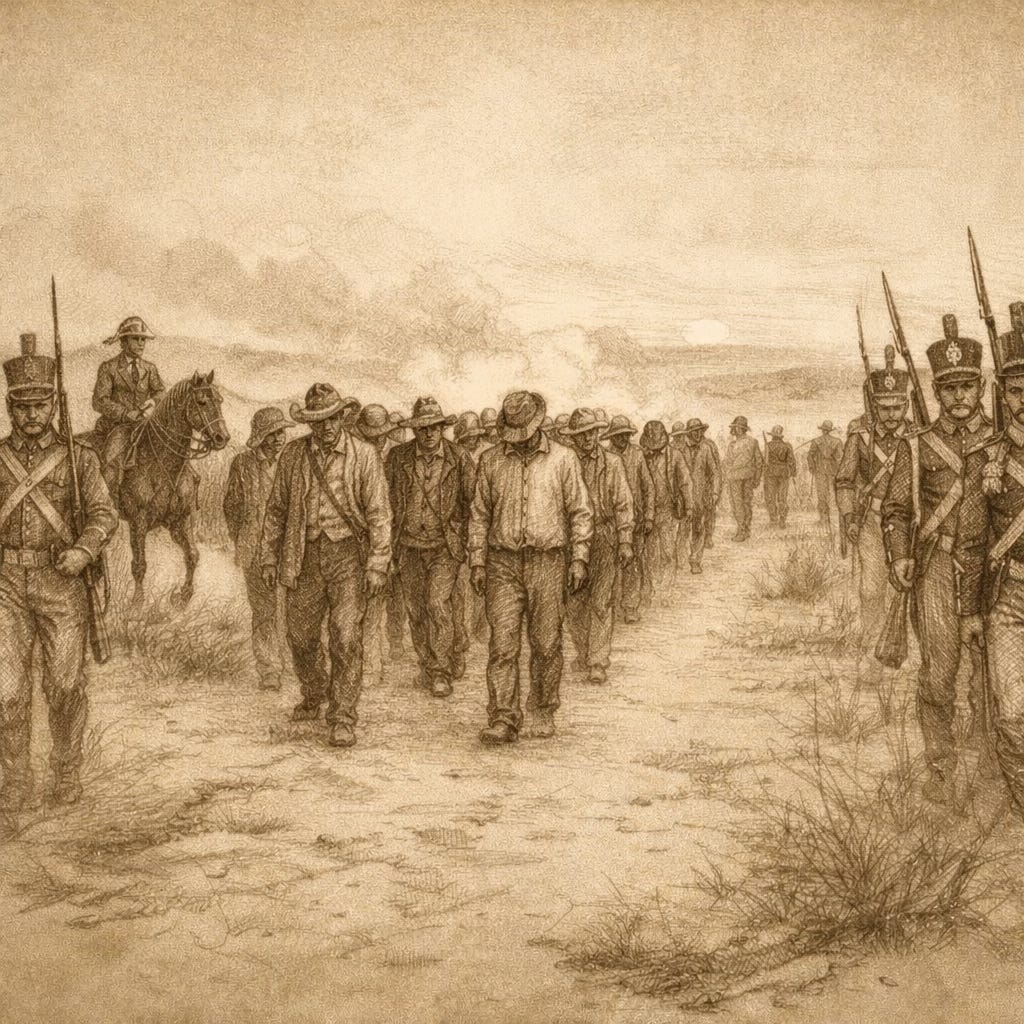
The sun came up over Goliad. Yellow, then white, then hard as iron. The kind of light that doesn’t warm you. The air was already dry enough to crack lips, and the wind came in small fits, carrying grit that stuck to teeth. It brought with it the faint sweetness of huisache blossoms from somewhere in the low draws, cut by the sharper smell of mesquite and dust.
The land was flat and open. Broken by thornscrub and the slow bend of the San Antonio River. Nothing taller than a man’s shoulders for half a mile in any direction. The road ahead was bare and straight.
We walked in columns. Fifty or so in mine. No one talked. Boots and bare feet kicked up dirt that hugged knees.
Mexican soldiers walked close. Too close. Men learn to walk beside power without meeting its eye. Most tyrannies begin this way. Rifles on shoulders, bayonets catching light.
We’d thought we might be going home. Some said the coast. Maybe parole. They told us we were going to gather firewood. No reason to doubt it. We’d been marched out for chores plenty.
A rider passed. Dark jacket. Silver on the hilt of his sword. He didn’t slow down. Leaned toward the officer at our front. Said one word. Rode on.
The pace quickened. A few of the boys started whispering. One of them laughed under his breath. The kind of chuckle men use when they know the joke is on them.
The road widened. Open ground ahead. No shade. No cover.
Someone coughed. Someone spat.
And then the wind shifted, carrying something over mesquite and huisache.
Black powder.
Faint, but close.
I knew then we weren’t walking to the coast.
We were walking into brush.
I had a moment, maybe my last, to think about how I got here. I wasn’t born in Texas. Most of us weren’t. I came from Louisiana with a borrowed rifle, a mule, and the promise of a land if we won.
Back then, the talk was about liberty. About Mexico’s constitution, the one Santa Anna had torn up. About how we’d fight for it like the settlers who fought King George. It sounded noble in taverns.
By March, it was just mud and fever. And the sound of men coughing into dank bedrolls.
The Mexican General Urrea had circled us for days.
We saw him now and then at a distance: Straight-backed in the saddle, watching through field glasses, officers clustered. Word was he’d fought in half a dozen campaigns. Men said he spared prisoners. We held onto this.
At Coleto Creek, we were caught in the open: Sun high, no water, no trees. Urrea’s cavalry circled. We fired until our barrels burned.
Fannin, our captain, called surrender. Said we’d be treated good. Urrea agreed. We stacked arms. Men slumped in grass, too tired to feel shame.
They marched us to Presidio La Bahía in Goliad.
Kept us behind the walls for a week. The guards weren’t cruel. They gave us rations. We even saw Urrea. He tipped his hat to a wounded man.
Then the General left.
The Mexicans who stayed did not tip hats.
That’s the thing about hope: It doesn’t die in a blaze. It leaks out. One order at a time. Like fatigue, it comes slow, almost unnoticed, until despair moves in quietly and gets mistaken for reason.
A man can feel the trap closing and still step forward, because hope is the last thing the heart ever forgets.
On the morning of March 27, they woke us before sunrise.
Told us we were moving. The sick and the badly wounded stayed behind in the chapel, too broken to march. At the time, none of us thought that meant danger. Urrea had promised fair treatment. Urrea had kept his word.
I stayed in the middle column. The one headed for open road.