

I didn’t think I’d die with a hammer in my hand. Face to the sky, eyes to the night.
But that’s how it went.
They’ll call me a rioter. I’ll call it grief with nowhere to go.
What do you call a man who finds his mother’s grave opened, her skull in a surgeon’s cellar, her burial clothes gone? What do you call a boy who’s watched loved ones interred, bones churned, and carted by lantern light?
You call him angry.
My name is Caleb Wright. Apprentice cooper. Second son. Lower East Side. The year is 1788. And here in New York, the dead do not rest.
We’d heard the whispers. Everyone had. The Negroes’ Burying Ground stripped bare. The bodies unmarked, unguarded. The bones carried by moon light. The grief? Unnamed. The thieves? Untouched.
The doctors didn’t dig themselves.
They sent boys with quick shovels. They paid in rum and silver. The graves they chose were shallow, the kind that didn’t draw mourners after the first week. Black graves. Immigrant graves. Pauper’s graves.
The city called it anatomy. We call it robbery. The city called it science. We called it sin.
But it was the grave at Trinity that broke all open. Not the Negroes’ ground this time. Not Potter’s Field. A churchyard, right in the shadow of a steeple.
We were poor. True. But born with the same dignity as those with degrees and titles. We are owed the same respect as those from classes above. Money does not measure the worth of a body.
We had fought a King over this belief. The belief every tyranny rests upon: The quiet certainty that someone else matters less.
The belief every tyranny rests upon:
The quiet certainty that someone else matters less.
A child saw small bones in the dirt outside anatomy rooms. An arm gnawed to tendon, tossed like scraps on a butcher’s block.
The story spread fast because it was about us.
Grief makes a quick education: Teaching faster, cutting deeper, leaving its pupils fluent in what cannot be forgotten.
We gathered. God help us, we gathered. Dock men with rope burns. Apprentices with barely a beard. Butchers who’d closed their stalls and came anyway.
April is a dishonest month. Too warm to hide the city’s rot. Too cold to absolve it. The gutters hissed. The air smelled of salt over sewage, gold over ruin.
No one talked much. What was there to say? We knew doctors were robbing graves. Now they’d been caught.
We also knew where those with credentials lived, where they worked.
Torches lit. Shovels in hand. Names whispered: Not ours, but the names of the stolen.
We were not yet a mob. We were not yet beyond it. But we were close.
We marched. We thought we could scare them. Shake the walls. Just to say enough.
Then they fired.
One or maybe two shots.
A scream. High. Raw. From a boy with no shoes. He’d climbed the hospital steps earlier, brick in one hand, rosary in the other. His sister’s bones gone and everyone knew it.
And then came hooves.
Not the slow clop of carriage horses. Rather the crack and gallop of mounted men. Coat buttons catching torchlight, coming to split and scatter.
The street was too narrow for grace.
Horses staggered on cobbles. One man tried to leap a fence, caught his boot, went down under them. The sound of hooves on bone is duller than you’d think. Like a mallet into fruit.
I lifted my hammer. Told myself I wouldn’t swing. But instinct is faster than dignity. I raised it as shield.
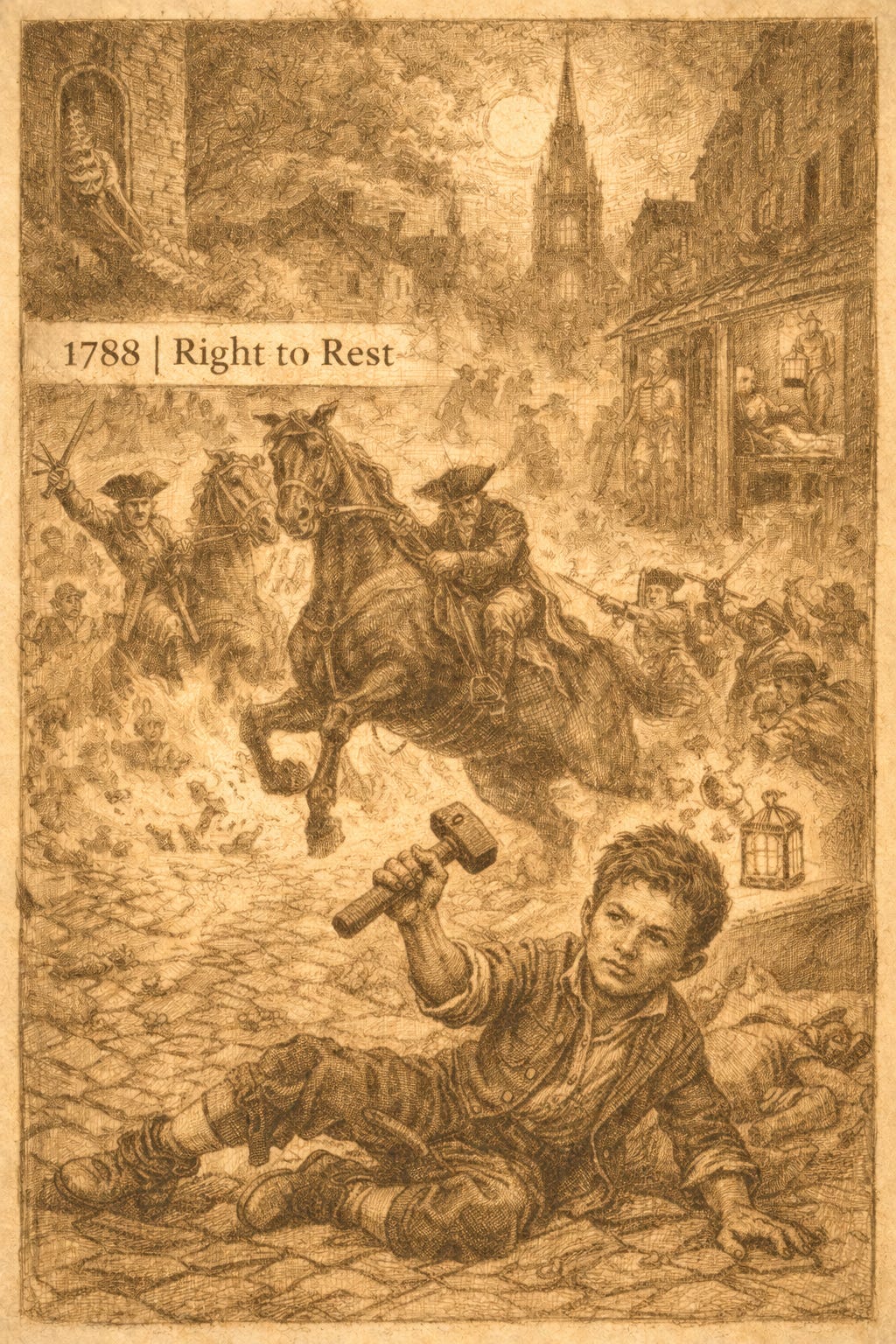
A hoof caught my chest.
No crack, just a deep thud of something folding. The street rushed up. My cheek stuck stone. Trampling isn’t quick. It’s a slow, pressing violence. My ribs gave way one by one. Breath went first. Then arms. Then time went with both.
The hooves don’t cut you open like a blade. They press. Compress. Distort. They turn you into something else. Something flat. My ribs didn’t snap all at once. They yielded, one by one.
I remember thinking: Power doesn’t have to hate us to kill. To kill us, it only need be certain we matter less.
They’ll tell it their way. That we rose up in ignorance. Stirred by superstition. Afraid of what we could not understand. An obstacle to the noble march of medicine. Haters of science.
We didn’t hate science.
We hated being its experiment.
We hated the men who ruled us in the name of science.
The surgeons were proud. Pious-proud. They wore their learning like armor, as if degrees could stop a brick. They called their mission sacred. We called our dead irreplaceable. They called us crude. We called it grief.
They told the press we were enemies of progress, as if progress could only be built over our mothers, our brothers, our unguarded graves. I know because I fixed their shoes.
Cruelty is most effective when dressed in the language of progress.
They spoke in Latin. Quoted Galen and Hippocrates. Wrapped themselves in black robes like judges.
You don’t need Latin to feel justice rot. You don’t need a diploma to know when you’ve been violated.
Even the poor can smell arrogance dressed as expertise.
Even the poor know when a nation trades dignity for dissection.
And even a rioter can love the humanity of a grieving grave.
So if surgeons wanted bodies so badly, let mine be their lesson. Let them cut, chart, and name bones after kings. Let them open my ribs and see what broke me. May the answer be clear: Their hubris.
You’ll find me there still. My cooper’s hammer in hand.
Waiting. Pressed into cobblestone.
Not for revenge. For the day they remember they were never gods, only men. Fearful men. Fallible men. Our fellow countrymen.
NOTE:
In April 1788, New York City was rocked by what became known as the Doctors’ Riot. Tensions had been building for years over the practice of grave robbing by medical students and physicians, who, due to limited legal access to cadavers, routinely exhumed the bodies of the poor, enslaved, and the unclaimed for dissection. The city’s communities had long protested these violations.
Authorities called in the militia to suppress the unrest. Mounted troops charged. At least six people were killed, some accounts say more. No doctors were prosecuted.