

They came at dusk. It was early April. A chill that clings.
One moment, I was humming. Dust in the rearview. Next, I wasn’t alone.
The truck behind me revved: Low, guttural. Like it was clearing before a curse. Rattling the side mirror and sending a warning carried on wind.
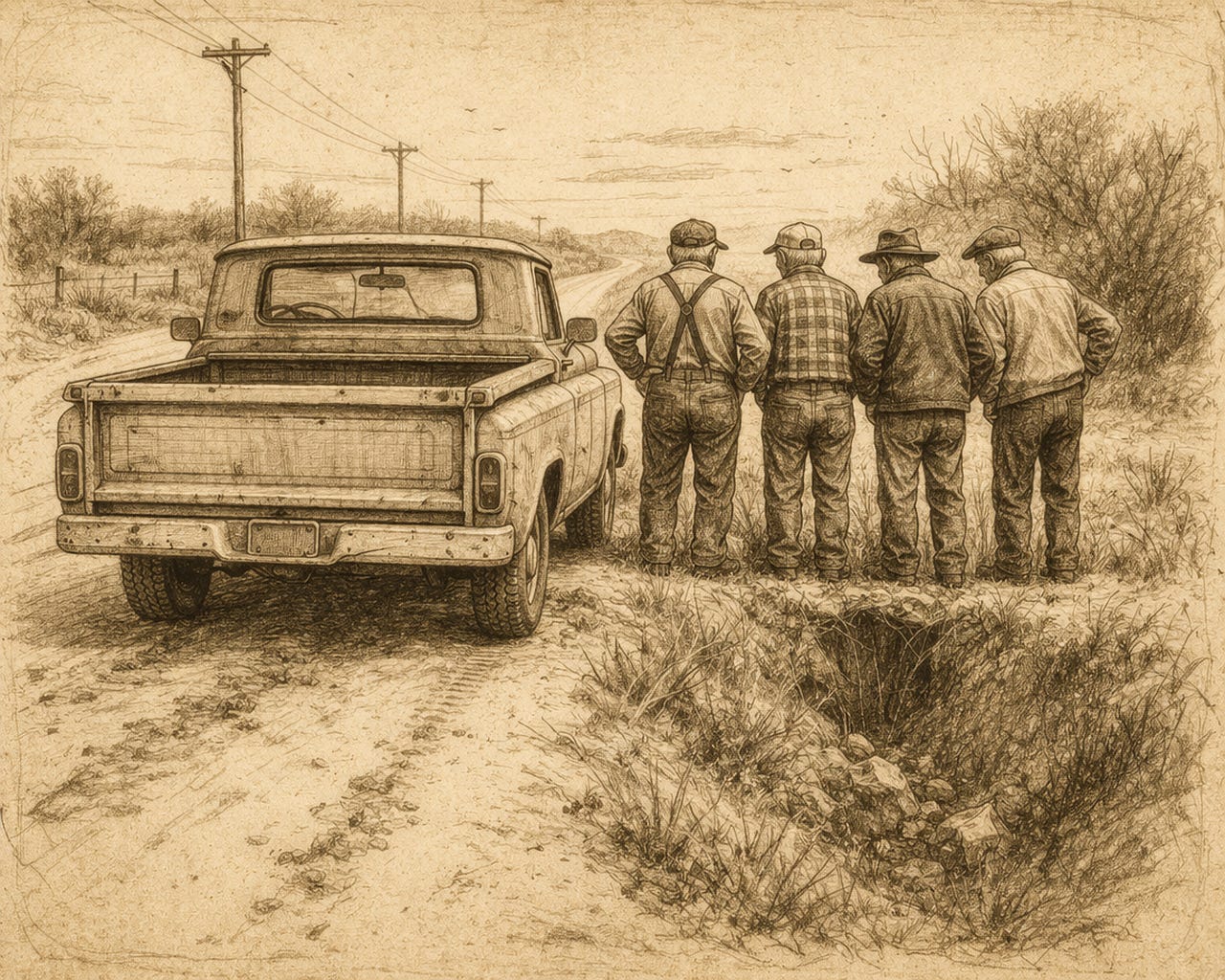
It looked like an old Chevy Stepside. Late ‘60s model. Paint rusted through at wheel wells. Chrome grille grey with road grime. The kind of truck outside bait shops and bars where men buy time with bourbon, bullets and blame.
Lights high. Horn short. Not a honk of warning. But a bark of menace.
I moved right. It matched.
I slowed. It closed.
When they finally forced me off the road outside Ypsilanti, I thought it might be a mistake. But when five of them stepped out, it was clear. White robes and hoods. I knew the old hatred had not died. It had put on a new cap. It had driven a pickup down a dirt road. It waited until dark to feel safe. Hate doesn’t die. Hate relocates. Hate waits.
Four years previously, neighboring Detroit had burned. 47 people died. Then, three years ago, they killed Dr. Martin Luther King, Jr. Gunned down. Assassinated.
The news didn’t hit like thunder. It felt like a bruise. Working its way up from beneath bone until apparent.
You only notice when the skin changes color; by then, it’s late. We knew the country was sick. Had been for years. We’d seen the fever, the twitching hands, the dry cough behind closed doors. We knew what happened to men who spoke too loudly in rooms not made for them. And still, when he fell, when Dr. King pitched forward onto that Memphis balcony, his fingers still curled around the railing, it felt like the whole country had sucked in breath and just… stopped.
Not crying. Not rage. Not even grief. Something slack. Something stunned.
Radios were blaring in cramped apartments, voices crackling with static. Women shouting into phones, boys kicking doors, sirens howling through dark. Fire in D.C. Fire in Baltimore. Fire in Chicago. Fire in Detroit again. Smoke rising like a second sky. You couldn’t find your grief. There was no map.
They said he had a dream. The country woke up to nightmares. And after Dallas, preferred it. After Memphis, confirmed it.
Afterwards: Some lit candles. Some loaded guns. Churches filled on Sunday, emptied by Wednesday. Preachers warned about judgment, but no one could tell whose they meant. You watched all of it from the porch, the television screen, or the back seat of a car.
His voice - clear as iron, cold as grief - hung in the air like a fog. More felt than heard. Less memory than marrow.
He spoke of Love. That was his crime.
I taught that love. This was my crime.
I tried to teach them about peace. About what Dr. King called beloved community. I wanted Martin Luther King Jr. Day recognized at Willow Run Schools not as a holiday, but as a declaration.
They weren’t interested.
One of them reeked of cigarettes and whiskey. Marlboros and Jim Beam: Smelled like my uncle used to. Another had motor oil under his nails, the kind you can’t wash out. His boots were cracked at the heel, farm sod crusted up the sides. Down from Cochota. From the diner. The older one had a wedding ring. Plain. Scratched.
They were methodical. Calm. The way people get when they think they’re right, and have waited to prove it.
Certainty is the cleanest cruelty: It costs nothing, kills without a sound.
They dragged me from the car by my collar. My shoulder hit gravel. I heard something pop. Could’ve been bone. Could’ve been pride. One man, older, heavyset, leaned in. “Shoulda known better, Wiley,” he rasped. His breath was wet with chew. Another spat brown on my shoe. Said nothing.
Metal. Cold. Hard. Right there, against my skull. Two barrels? One? I don’t know. I couldn’t turn. Couldn’t breathe. Time didn’t stutter: It jerked, snapped like a live wire. The air thinned. Everything pulled back. Sound. Light. Breath. God. All gone.
Just me. And that barrel. And a thought: This is it.
The pain hadn’t even come yet. But I knew it would. I knew it was coming.
I didn’t scream.
It wasn’t fire. That’s a myth. It is worse: Low heat that spread slow, like molasses and menace. Sticky. Creeping. It coated. Clung. Tightened. Tar finds you the way shame does. Starting at skin, ending in bone.
Then feathers. Like snow. Like a bad joke no one wanted to explain.
I remember the smell first. Tar. Hot. Sticky. It clung in my nostrils. In my hair. In the back of my throat. Then those feathers. They fell like ash.
The men with hoods laughed.
I did not cry. Not then. Not later. I felt the tar against my skin, thick and dragging. Every move a protest. The feathers whispered when they struck ground. My eyes burned. Not from tears, but from smoke and shame. And something older. Something that stayed.
They didn’t know this: I had already chosen. Long before they ever saw me. Before I stood in front of classrooms and said, Look around you. This is America. She’s still becoming. Better is still ahead. My father taught me this.
He worked a line in Detroit. Hands calloused. Knuckles split. His voice low and steady. “Wiley,’ he’d say, ‘hate wins battles. Battles. But never a war.”
He didn’t say it loud. He didn’t have to. He said it enough times it stuck.
I remember the weight of tar. How it pulled at my clothes like wet fingers. How it pressed. Like gravity. Only heavier. I remember feathers sticking to my arms, my face, my chest. One caught in my eyelash. Another my beard.
They weren’t laughing now.
Just watching.
This made it worse. Their earlier laughter— sharp, cruel, full of teeth — still echoed faintly. But now it had curdled into silence. Into expectation. Like they expected me to break. To beg. To disappear. But I’d seen too much hope in kids who hadn’t learned to hate. I couldn’t vanish. Not then.
So, I healed. Not fast. Skin slow. Soul slower. I showed up again at Willow Run. The next day. Raw in skin. Whole in will.
A student left a note in my office: “We’re proud of you.” I kept it in my wallet. Folded it each morning like a prayer. In ’74, I moved to another school, more voices, and more chances.
When people asked why I didn’t quit, I told them, “Because I believe in America. And I believe America is better every day.”
You think it’s easy? To keep believing after being marked? After the tar sticks to your shirt and the laughter echoes? No. It’s not easy.
Easy seduces. Easy sedates. Easy steals.
We get to greatness the way we get to morning after a bad night: By enduring it. Trial. Mistake. Correction. Failure only finishes things it stops. And stopping is the easiest thing in the world. Which is why it should scare us.
But better is possible. And that’s what makes us American. Not perfection, but persistence. Not purity, but progress. Not arrival, but the road. Always the road.
Especially when we fall.
And long after, when the feathers have fallen and the classroom is quiet, that same certainty waits: Patient. Unrepentant. Ready to strike another match. It is the smoothest path to cruelty. It is not the men who doubt who destroy. It is the men who are certain. Doubt asks questions. Certainty buries them. It’s killed more than doubt ever dared.
The men who did this: I forgave them.
They went to prison, a demand of justice. But the hate, their hate, didn’t get to stay. It didn’t pass into me like poison in a wound. It stopped where it started. I won’t carry it, won’t keep it warm. I hope they find something better in themselves, because people can. Even nations can. Not always, but sometimes. And sometimes is enough to keep hope.
I lived long enough to see classrooms change and Dr. King’s name etched into calendars and chiseled into marble. But more than that, I saw his dream. Our dream: Every day, it walks into homerooms in sneakers, with braids, and brown skin, and lunchboxes, and hope.
Saw black kids raise their voices without apology. Saw white kids raise their hands without fear. Saw them laugh together. Argue together. Learn together.
That’s the miracle. Not the monuments. Not the speeches. Not even the marches. The everyday act of choosing.
People get confused. Good intentions don’t always clear the fog. They think strength comes from difference or sameness, depending on the season and the speech. But it’s neither. The strength is in the binding, not the parts. Unity. The hard kind. The kind you choose, again and again, in traffic, in voting booths, across dinner tables gone quiet. Out of many, one. That was the idea. Still is. Better—not perfect; not pure—just better. Together, if we will it.
The strength is in the binding, not the parts. Unity. The hard kind. The kind you choose, again and again, in traffic, in voting booths, across dinner tables gone quiet. Out of many, one. That was the idea.
America is not finished. She never has been. Never will. She’s still becoming.
Somewhere right now, in some classroom with cracked tile and scuffed desks, a kid is asking a question no one thought to ask yesterday. Another is answering, shy but steady.
And it smells nothing like tar. It smells like pencil shavings. Like paper. Like possibilities. Like a new start.
And it sounds like sneakers squeaking. A bell ringing. A girl humming off-key.
It sounds like a teacher saying, “Good morning.” And twenty voices saying it back.
NOTE:
On April 3, 1971, three years after the assassination of Dr. Martin Luther King Jr., the Willow Run School Board, located outside Ypsilanti, Michigan, held a meeting to discuss how to commemorate Dr. King’s legacy and work. It was hotly contested. Local school principal Dr. R. Wiley Brownlee spoke in favor of the topic.
On his way home, local Ku Klux Klan members pulled him over, put a shotgun to his head, and poured hot tar from his shoulders to toes and feathered him before leaving. He was married with children. He resumed working the next day and never caved to the violence of hate.