

The air in Algiers was all salt and sun-baked stone, the kind that finds the pores and stays.
I stood at the edge of the quay, the sun pressing down. No chains at my ankles for the first time since twenty-two.
My skin was red where the irons had been, rubbed raw in rings. The breeze found those places, ran over them slow.
Then, I heard my name.
Said carefully. I had not heard my own name in many years. For this past decade, I had been ‘abd or yarak. My noun was heard in the tone of a sharp bark.
My name, “John Foss,” was startling. It was said flatly, without threat.
I stepped forward.
It was July 1785 when they took us.
Our ship, the Maria, ran easily toward Cádiz. The Atlantic crossing had been typical, fraught with challenges but surmounted. Now, as the Spanish coastline appeared, the warm, calmer waters were welcome. The air was fragrant.
Yellow-legged gulls hung in the wake, their cries folding into the sound of water on our hull. Farther out, shearwaters carved lazy arcs over the swell, as if the sea itself had grown wings.
The men’s voices rose with the swell: Easy and unhurried.
Then our lookout called “sails.”
They showed first as gray triangles against haze: Lateen rigs. Small at a distance. Gaining shape as the minutes drew them closer. Too fast for the wind we felt. The black hulls came next. High sterns. Bow guns glinting. Someone muttered, “Algiers.” Another crossed himself.
The first shot came wide. As it passed starboard, it hissed into water.
The second carried splinters across our rail. The captain shouted for more sail. It was too late. Their hulls closed.
Grappling hooks bit. Lines snapped taut.
They came over the side. Bare feet. Blades flashing. Shouts in a stiff, sharp tongue. One of ours swung an oar. It was knocked from his hands. I saw a blade catch sun. Then disappear into the shoulder of the man beside me. He folded without a sound. His wound sprayed across my face.
They moved like rustlers splitting livestock. Precise. Purposeful. Practiced. All of it swift. A hand closed on my knife before I thought to pull it. Belts, hats, and shoes ripped off. My coat, my only decent one, was torn from its peg and tossed onto a pile.
The captain tried French, then Spanish. A blow from the back of a cutlass sent him to the deck.
They tore through the hold as quickly as they stripped us: Barrels rolled up and split with the flat of a blade, tobacco spilling dark and sharp-smelling onto the planks.
Even the ballast stones we’d taken on in Boston were rifled for anything tucked between them. The ship’s work, months of loading and lashings, was undone in minutes, our cargo scattered and claimed.
Shoved. By some hand or hands. All of us, driven toward the hatch. The first mate forced forward toward the bow, the captain dragged aft by his collar. My chest tight, breath caught somewhere above my ribs. The deck tilted as I stumbled.
Men pressed shoulder to shoulder, saying nothing. The hatch slammed. The light died. Orders in a language we did not understand. The quick thud of a fist hitting flesh.
Below, the air hit like a wall: Thick, wet, enough to slow blood.
We stayed like that through the night, rocking without any sense of where we were headed. Yet, we were still alive. The air grew hotter, as if the dark itself was burning. By morning, the motion changed: Slower now, the pitch and roll gone. Calmer waters.
Then voices. A roar arose, hundreds together, thick as surf. Next came a sound I had never heard, long and high, falling back on itself like a wave breaking in slow motion: A call to prayer. It hung in the air, alien and certain —like the braying of some spirit demanding submission.
Then the hatch swung open. Hands were on us again.
They led us down a gangplank in pairs. Chains clinking against ankles. The boards were hot enough to sting.
We were herded through the crowd, guards at our flanks with short whips of plaited leather. Someone spat. Someone laughed. I looked once toward the water, toward the ships at anchor. None flew a flag I knew.
Onshore, the crowd pressed in. Faces framed by hoods and turbans, gold catching the light in their ears, their teeth.
We walked the length of the harbor wall. Not marched, just moved forward at the pace irons permitted. Men called out in voices I didn’t know, laughter catching on the edges.
We were a line of goods now, already marked. Strong backs. Bad teeth. Young enough for labor. Old enough for an oar. The smell shifted as we left the harbor: Fish and tar giving way to dust, animal dung, spices sharp enough to bite.
At the market, they made us stand while others were sold: Men from the Dauphin, stripped to the waist, their skin pale against dark stone. Buyers circled the way I’d seen farmers in Portsmouth pace a horse. A price called. Silver exchanged. A man led away.
When my turn came, there was no bidding. A guard jerked his chin, and I was passed to another. Given a coarse tunic.
They didn’t just hand us tunics and turn away. We were made to stand there, naked, holding them. The eyes of the crowd worked deeper. Children pushed forward to point.
One man spat on the ground in front of me. He said something to his neighbor that made both smile. A guard prodded the ribs of the man beside me with the butt of a whip, tilting his head for a better look, the way you’d check the health of a mule. The smell in the square was a mix of sweat, hot stone, and the spice-sweet smoke from some cookshop just beyond the wall. The smell made my stomach twist, not from hunger but from knowing it had nothing to do with us.
It went on like that until the sun stood directly above. The heat pressed down. I tried to keep count of the men from our crew but lost it somewhere between twelve and fifteen.
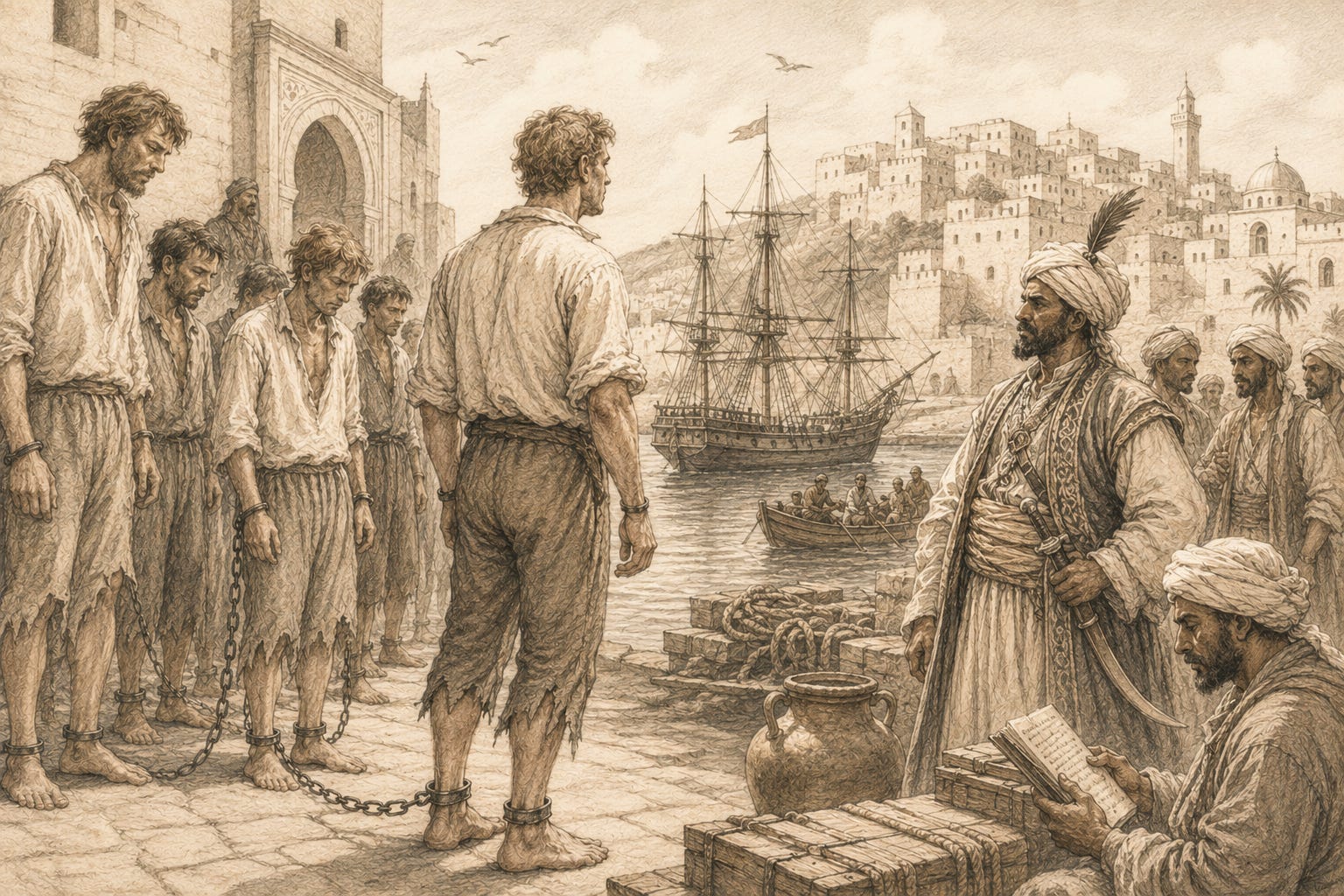
By late afternoon, they moved the rest of us to a low building at the harbor’s edge. Inside, it was cooler. The air was thick with the smell of tar and wood shavings. Ship timbers lay stacked along one wall, tools against the other. A man with a scar over one eye pointed to a cart, then to me. I learned later this was the shipyard, and I would be hauling oak and pine from one end to the other until someone decided otherwise.
That first night I lay on the ground with a dozen others, the fetters between our ankles set at just the distance to rub the skin raw. I listened in the dark for an English word. There were none. No one from home. I was eleven years from America and did not know it.
By dawn the irons had split the skin at my heels. I learned to turn my feet outward to ease the bite. There was only the burn, and the next step, and the step after that.
I woke to the scrape of chains on wood, the sour smell of sleep and unwashed men. The chains across my ankles were familiar now, almost part of the bone. The legs went numb in the night; when feeling returned, it came back sharp, and the skin split where metal pressed.
A man survives not by killing time but by cutting it small enough to carry. You did not think of the year, or the decade. You thought of the next pail of water, the next plank to be hauled, the next shadow of a wall where the sun could not touch. You measured time by meals.
And when no one was watching, you held something back from them: A memory of home. The shape of a shoreline. The New England autumn. The exact shade of sky before rain.
By dawn the yard baked. Quarry stone carried until the weight burned through the shoulders and the whip-man called a halt. Then water duty, the skins slung on a yoke, the leather cutting the neck. The chains never came off. Their links sang at my heels, a sound I stopped hearing and never stopped hearing.
The sun cared nothing for blood or breath. Quarry dust caked the throat. Pottery jars cracked in your hands. Oars turned your back to wood and your hands to strangers.
Food was only a measure of the next day’s work: Coarse bread that scraped the tongue, oil gone rancid, water that tasted of clay or brine. Sickness moved quietly between men. Fever. Cough. The yard heavy with the putrid smell of flesh rot.
Punishment came without warning. A man could be carrying water one moment and on the ground the next, his tunic split open down the spine by the first lash.
The air changed when it happened. The hammers and shovels fell still, the yard turned to silence, waiting for the sound to stop.
The bastinado was worse. They’d bind the ankles. Strike your soles until the skin splits and blood ran in the dirt. Walking after was a slow, sliding thing. Each grain of sand cut like glass.
One man took a blow to the shoulder from a falling timber. Within a week, the flesh turned black at the edges. Flies found him before anyone thought to help. He kept working until he couldn’t lift his arm, and then they took him away.
I learned pieces of other tongues from the men who shared our work. A Maltese who’d been caught in the same waters, a Spaniard from the Dauphin, a Frenchman whose skin had burned raw in the sun until it blistered. We traded words for bread crusts, for news, for the sound of something that wasn’t a master’s order.
The yard was all Christians. Maltese, Spaniard, Frenchman, myself. Never one of their own. I asked the Maltese why, once, and he said it was their law: a Christian could be taken and worked and sold, a believer could not. Not a thing they hid or argued.
There were stories of escapes. One was a Sicilian who got as far as the harbor’s edge. They brought him back on a cart. His ankles bound in a way that made skin bulge. They kept him alive for three days. Made sure we saw.
Eyes were always on us: Guards on walls. Informers in the yard.
I stopped keeping track of months. The seasons blurred until I counted the years by the rhythm of Ramadan, the shifts in the shipyard, the changing of overlords.
Then one morning, another captive passed close enough to murmur news: Ships from America were coming. Not here yet, but coming. I let the thought turn over in my head for days. Hope was a dangerous thing in Algiers.
For nights after, I let myself think of home, of the sound of gulls over the Portsmouth harbor, of streets that smelled of pine boards and fish instead of dust and heat.
The news came in pieces, carried by men who didn’t always agree on details. September of ’95, they said. A treaty signed. America had paid ransom. Not just for me, for all of us. One hundred or more names, each bought back for a price.
It should have meant the gates swung open. It didn’t. Months passed.
The work never ended. Chains stayed. We heard about ships coming but saw none. Then about silver counted into neat stacks, names written out in a hand none of us had seen.
In July ’96, they called the first list in the yard.
We stood shoulder to shoulder. A man holding a folded sheet read the names in a flat voice. When a name was called, the man stepped forward, and the chain at his ankle was struck once, cleanly. Then he walked out the gate.
I waited.
The list ended.
The next day, they read another.
Still nothing.
By the third day, I had learned not to breathe until the pause between names began.
When mine came, I almost didn’t hear it. I repeated it, louder, and the man with the sheet nodded without looking up. The hammer struck.
I walked through the gate without the drag of iron. I could feel the stone under my bare feet, hot but not biting.
Past the fortress where I had first been taken, past the market where I had stood in a line waiting to be bought. The call to prayer sounded, just as it had on the day I arrived.
On the quay, a ship waited.
The wind was moving in the right direction. The deck was open, the horizon clear. Behind me, the city leaned against the sky, its walls writhing in sun, and for the first time in eleven years, it was getting smaller.
From the deck, I looked back.
The white walls of Algiers, the fortress high above the harbor, the market square hidden but still there in my mind. The wind shifted, warm off the land. We put out into the open water, the sails drawing full, the city falling back.
It was the same sea I had crossed to come here, the same horizon, but this time the wind was mine.
The first breath of home air was sharp with pine and salt. Cooler than I remembered. The dock boards creaked under my steps, unchained, and the sound seemed loud in my ears. Somewhere down the wharf, a bell was ringing.
I ate bread that did not scrape. Meat cooked in butter, fresh water drawn cold from a pump. I slept without iron at my feet, without someone standing over me. It nearly undid me.
Freedom was not the thing I had imagined — banners and trumpets, fireworks, the ballot. It was walking where I chose. It was waking without the weight. It was speaking and knowing the man in front of me knew my name.
The scars remain. Some you can see. Others come back at night.
But the country I returned to was not finished. On the docks at Charleston, cargo was still counted in human beings. I had worn those irons. I had learned their weight by the season, hot in summer, tight in winter, always at the same raw patch. I knew what it was to hear a man’s name called out as a bark, and to wonder if it was still his.
To shackle one man is to size a chain for oneself.
NOTE:
John Foss, a sailor from New Hampshire, was captured by Algerian corsairs in July 1785 and enslaved for eleven years. He was freed in July 1796 under the U.S. Treaty of Peace and Amity with Algiers, which ransomed roughly 115 Americans for about $642,500 and promised an annual tribute — a sum approaching a fifth of the young federal budget.
The Barbary states held that Islamic law made the enslavement of non-Muslims lawful; Muslims were not taken. When Thomas Jefferson and John Adams asked Tripoli’s envoy in London by what right his nation seized American ships and men, he answered that it was written in their law and the authority of their Prophet. That doctrine, not commerce or reprisal, was the root of the conflict, and it became a cause of the First and Second Barbary Wars.
The Arab and trans-Saharan slave trades predated the transatlantic trade by centuries and, over their far longer span, carried a comparable number of Africans into bondage. Arab bondage enslaved more than 20x what was deported to North America.
The practice has never fully ended: hereditary slavery persists in Mauritania, which abolished it only in 1981, and open slave markets were documented in Libya as recently as 2017.